Aiming for the stars!!
A REPORT ON THE EVENTS AND ACTIVITES ORGANIZED
BY THE CLUB IN YEAR 2006-07
CONTENTS
- GENERAL
REPORT...................................................………………………………
Trupti Ranka
- MOBILE PLANETARIUM
………………………………. …….. ………………… Mohit Karve
- KAMSHET STAR PARTY ………………………………………………………….
Nachiket Gokhale
- ANNUAL GATHERING SKY
SHOW……………………………………………… Nachiket Gokhale
- MESSIER MARATHON
…………………………………………………………….. Nachiket Gokhale
- PARTIAL SOLAR
ECLIPSE………………………………………………………… Aditya Nanavty
- GUEST LECTURE ON
SETI………………………………………………………… Nachiket Gokhale
- TELESCOPE MAKING
WORKSHOP.......................................................................
Mohit Karve
- SOME PHOTOS
General Report
The CoEP Astronomy Club had a wonderful year full of interesting events in the year 2006-07. This year the club was successful in reaching out further to the college students and generating in them a curiosity for the field of amateur astronomy. The club achieved this through regular meetings and a number of events like mobile planetarium, outdoor star sky observing sessions, guest lecture and workshop. The first official meeting of the club for this year was held on 3rd august 2006. During the meeting a DVD named ’15 years of Hubble space telescope’ was screened. The DVD is a special documentary made by ESA (European Space Agency) about the making of Hubble space telescope and its contribution to the field of astronomy and astrophysics. The club members then met regularly on every Tuesday to discuss general topics related to theoretical and practical astronomy. This helped to form a group of about 20 regular members plus about 20 more not-so-regular members. Two outdoor sky observation sessions were conducted in the month of January and March. In the month February two club members Snehal Naphade and Suraj Sonatake designed T-Shirts for the club. The club also bought its own six inch Newtonian reflector telescope in the month of March. By the end of the year at least 20 members could identify the major constellations in the sky and at least 8-10 members became skilful in handling the telescopes and spotting deep sky objects. Also a telescope making workshop was conducted in the month of June, as a result now eight club members have their own telescope The club is not only helping the students to learn astronomy but is also imbibing in them a sense of scientific and technical reasoning by involving them in activities very much different from regular classroom lectures and lab-work.
We are thankful to our staff advisor Prof. S.D. Agashe for his constant support and advice to club. We are also grateful to the alumni and especially to Mrs. Anjali Nandekar for supporting our activities and also funding the telescope making workshop. A special thanks to Ms. Snehal Naphade of third year IT for her whole-hearted efforts and support to the club activities. She holds the distinction of being present and participating actively in each and every club event.
The club hopes to continue with same or even greater enthusiasm in the years to come. We also plan to undertake the work of reinstalling an old 12” cassegerian telescope owned by instrumentation department in the coming year.
- Trupti Ranka
Third year Instrumentation and control department
Mobile Planetarium
During the first year of COEP astronomy club i.e. 2005-2006 the club organised a number of events to educate its members about the hobby of astronomy.
However, these activities were restricted only to the members of the astronomy club. We are committed to spreading interest in astronomy to all the college students who were even remotely interested. Thus, a decision was taken to organise an event that would take astronomy to the college masses. It was decided to bring a mobile planetarium to the college, where all visitors would be introduced to a virtual night sky by the club volunteers. The greatest convenience of a mobile planetarium is that sessions can be held even during the daytime. Also, the entire sky that is visible throughout the year can be shown in a span of an hour.
The Astronomy Club, in association with the IUCAA (Inter University centre for astronomy and Astrophysics), brought the mobile planetarium to the college on the 13th of October, 2006. The event was spread over three days, 13th, 14th and 15th of October. The first two days were reserved exclusively for members of the staff of COEP and its students. The grand event was inaugurated by the Director of COEP, Prof. A.D.Sahasrabudhe.
The first show to be held was of course only for the staff members. Later through the day, shows were held for the students of the college. The planetarium attracted many students; most of who were awe-struck by the beauty and thrilling experience of visiting the planetarium
On the third day, the planetarium was thrown open to the general public, and the response received was fantastic. The crowd consisted mostly of families of students who seen the earlier shows, though there were many visitors from outside the college as well. The event went off very smoothly, despite the large volume of people that the club was handling. Also, star maps were given out that gave an idea of the night sky on that particular day. We hoped that this would encourage visitors to engage in a little sky-watching of their own!
The event finally ended on the 15th of October. This was the busiest day of the three day event, attracting even more visitors than the 14th. Once again, the event went off without a hitch, thanks to the efficiency of the enthusiastic volunteers. The programme was a roaring success and we received an overwhelming 400 visitors! This event, more than any other, showcased the fact that most people are inherently interested in astronomy, though most don’t follow it up as a hobby. Hopefully, this event might have changed people who were merely curious into people who were deeply interested. The club thanks to Mr. Arvind Paranjpye and Mr. Sameer Dhurde of IUCAA for their co-operation and support.
Mohit Karve,
FY.B.Tech (production)
Kamshet Star-Party
COEP Astronomy Club continued in its sincere efforts to accentuate the interest of budding engineers in Astronomy and allied activities. After the inspiring events that included screening of documentary-"Making of Hubble Space Telescope”,"Mobile Planetarium", and regular discussions on practical and theoretical astronomy, the next one to in the series of these exciting activities was Club's first outdoor sky observation session (Star Party) .It was first of its kind in our college, held at a remote village, kanshi, near Kamshet on night of 19-20 Jan 2007.
Twenty-two Club members comprising mostly of first and second year students and few experienced senior year students practiced the skill of handling telescopes and hunting the astronomical objects under clear night sky. The site being far away from the city lights provided excellent sky conditions for serious astronomical observations. The students there got acquainted with bits and pieces about mounting, collimating and using telescopes to find planets, stars, M-objects (some deep sky galaxies nebulae and star clusters), identifying constellations and other celestial delicacies throughout the night with the help of star charts, catalogues and maps. The observations were concluded with a concise summary of the night-sky and its significance. Moreover, observing planets like Venus, Saturn and Jupiter with such high resolution was something which was enjoyed and appreciated by everyone.
The entire event was aimed at motivating and training students to handle telescopes and star-maps, efficiently. Thus, encouraging them to take part in far more challenging observation sessions and projects. The event provided a titanic start to club's night-observation activities of this year!
Nachiket Gokhale,
Second year ENTC
Annual Gathering Sky
Show
The Astronomy Club of C.O.E.P ,maintaining its efforts in motivating engineers in sky study and exploration, conducted a 'SKY SHOW' at GPP Boat Club on 3rd March,07 between 7.30 to 9.30 pm.
The members of the club arranged 3 telescopes [2 Alta-Azimuth & 2 Equatorial] to hunt for few sky novelties which included M-42 nebulosity in constellation of Orion] and Saturn. The Full Moon, with its captivating craters was lauded by everyone out there. The club members explained the visiters all the visible star constellations and planets. The event concluded with the senior members of club giving answers to the doubts and queries put before them. The show was attended by almost 150-200 students whose positive response about this unique event served to boost the efforts of Astronomy Club members.
The event also served as a good learning process for the club members also, who tracked the sky objects with telescopes .The show was another feather in the cap of the club.
Nachiket Gokhale,
Second year ENTC
Messier Marathon
This semester Astronomy Club conducted many phenomenal activities and "The Messier Marathon" was one such event which further increased students' zeal and enthusiasm in club activities. It was on 17-18 March, 2007 (a night in the Messier week) that few representative students of all four years went to Khandshi, a remote village near Pune via Kamashet to hunt for the Messier objects.
Messier week (usually occurs in March) is a period during the year in which all 110 Messier-objects (which mainly consists of galaxies, nebulae, and star clusters) can be observed during any one single night of the messier week. The activity was carried using two telescopes-one 6” Newtonian telescopes with alt- azimuth mount of club and other 6" telescope with Equatorial mount. In spite of having a cloudy night sky, around 40 M-objects were successfully observed which consisted of many nebulae-like Crab nebula, Orion nebula, Little Dumbwell and galaxies-like Pinwheel, Whirpool. Sagittarius star cloud, Butterfly cluster, Hercules globular cluster were some other awesome M-objects. All the objects were tracked in sequence using ideal serial sky maps: Norton and Wiltron 8 magnitude star charts. Tracking and spotting the objects with high magnitude (low brightness and hence difficult to spot) was a difficult job but the consistent efforts of the students throughout the night helped them to spot about 40 objects.
The activity basically aimed at spotting out difficult sky objects using maps. The event provided students fair amount of skill to be adept in searching faint things in night sky. Club is planning to organise many such inspiring and stimulating activities in days to come.
Students participated in Messier Marathon observational activity on 17-18 March, 2007:
Shrikant Vinchurkar (shrikant2410@ yahoo.com)
Nachiket Gokhale (nachiket.gokhale@gmail.com)
Snehal Naphade (snehal_2710@yahoo.com )
Kshitija Deshpande (kbdeshpande@gmail.com)
Nachiket Gokhale,
Second year ENTC
Partial
Solar eclipse event
COEP Astronomy club began the Indian New Year in a grand way. On 19th march,
special viewing of partial solar eclipse was arranged. Around 20 members of the
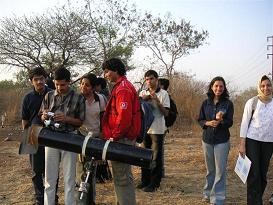
club gathered at Talajai hills, Pune in the morning to witness the partial
solar eclipse. The eclipse, which commenced at 6.44 a.m., was visible till
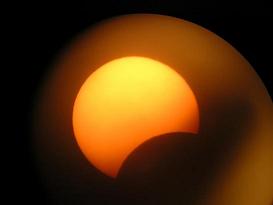
around 8.00 a.m. The sun rose with 23% part of it covered by the moon and
eventfully the complete sun reappeared by 8.00am.
Members viewed this beautiful wonder in sky with a scientific point of
view. Science behind eclipses was discussed while watching it. Necessary measures
like use of filter lenses, pin-hole cameras etc. were taken for eye protection.
Equipped with a Newtonian telescope which was protected with a milar film to
filter out the strong solar radiations for a better and safer view of the
eclipse. Some eager local residents were also shown this astronomical
spectacle. Few photos captured at the event even made their way to popular
astronomy sites. The event was a very memorable experience and increased
awareness about eclipses amongst the members. An eclipse related detailed talk
was organized the very next day at the regular club meeting. Going by the
feedback of the members, the event was yet another success for our club.
Aditya Nanvatey
FY.BTech (production)
Guest
Lecture on SETI
On 18th April, 2007 a guest lecture by Vishal Gujjar associated with
National Centre for Radio Astronomy (NCRA) was held by Astronomy Club of COEP.
The lecture introduced the club members to the field of Search for Extra
Terrestrial Intelligence (SETI).It was attended by almost more than 40 students
The session commenced with introductions to programmes undertaken
hitherto for SETI like OZMA, CYCLOPS,BETA, META etc. Vishal briefed to the
students two types methods used to search extra-terrestrial life: the Targeted
search and All Sky Search Methods and explained to them about the existing
technological utilized in SETI.
The lecture enlightened students about selection of the critical
parameters like frequency (H-OH/Hydrogen Emission) and bandwidth for the
purpose of SETI.
Though the subject of SETI may be seen as a waste of time and energy by
many people across the globe the lecture emphasized on the ways in which every
person on earth with a personal computer and an internet connection can
contribute to SETI with zero investment of time and money and effort.
The lecturer talked about a subject so fascinating and mystifying that
it surely increased the interest and awareness about the subject in the
students.
Nachiket Gokhale,
Second year ENTC
Telescope Making Workshop
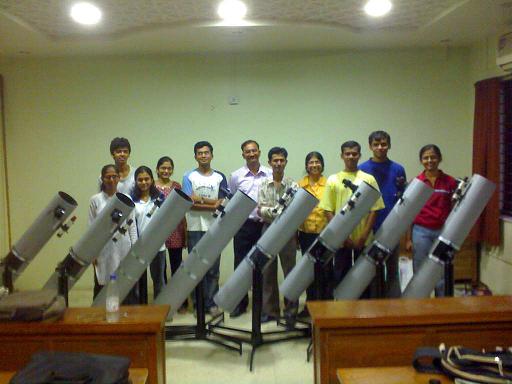
After the various events organized by the CoEP Astronomy club this year, the club organized one last event to finish off what has been a successful year for the club. This was the 16-day telescope making workshop for members of the astronomy club. Eight first year students took part in this workshop, and at the end of the workshop, took home their very own, custom built telescopes. The participants were:
- Abhishek Bawiskar
- Aditya Nanavaty
- Chetan Gokhale
- Jayesh Mutha
- Mohit Karve
- Shraddha Naphade
- Shrikant Vinchurkar
- Soniya Deshpande
The following were the volunteers:
- Shachi Pande
- Shehal Naphade
- Trupti Ranka
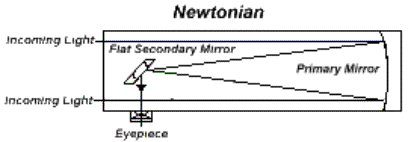
The Newtonian telescope with a 6-inch reflector was decided as the ideal design.
The figure shows the basic structure of the telescope optics. The 6” reflector telescope indicates that the primary mirror of telescope has a diameter of 6 inches.
The three important aspects of the telescope are:
- Light gathering power of telescope which is directly proportional to the area of mirror
- Magnification = (focal length of primary)/(focal length of eyepiece)
- Resolution = 1.22 (wavelength of light)/(mirror diameter)
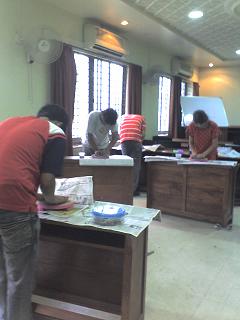
Mr. Tushar Purohit, a telescope making expert, was roped in to guide the students through the process. The workshop commenced on the 4th of June. The most important part of this telescope is its primary mirror. Students were given a circular glass plate, which was to be ground in order to give it a concave shape. This grinding was done with the help of a range of carborundum (Silicon Carbide) grit powders.
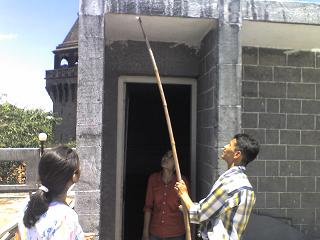
To start off, a grit size of 120 was used. The number with the grit size indicates the size of particles in parts of an inch, i.e. a grit rated 120 will have particles that are 1/120th of an inch in size. This grit is used to bring about the sagitta of the mirror. The sagitta is basically a state where the mirror has achieved its basic curvature. Once the sagitta is achieved, the mirror must be ground so that its focal length approaches 48in. the focal length was checked by taking the suns image on the terrace. The focal length is the distance between the mirror and wall when a sharp image of sun is focused on the wall. After the mirror fulfils the requirements, it is then successively ground with lower rated grit powders, so that the opaque surface caused by the coarse powder is transformed back to the original reflective, polished surface of the glass.
Typically, the sagitta can be attained with about two hours of grinding. This was affirmed, as most of the participants attained the sagitta within two hours. Next, a 220 grit powder was used. After about four hours of grinding, the glass surface was smoothened enough to move on the next grit size, rated 320.
The 320 grit is basically the last grit size where there is any chance of the focal length. So, care must be taken to ensure that if the ideal 48in focal length is achieved, then it shouldn’t vary. Also, if the 48in is not achieved, this is the last chance that there is of achieving it. From here on, it’s all about smoothening the surface. After about three hours of grinding with the 320 size, the entire lot moved onto the next grit size.
At grit size 400, the new task is to rid the surface of pits, or irregularities on the glass surface. It’s the same for sizes 600 and 800 too. After about eleven hours in total on the three sizes, it was time to move on to the last two sizes, 1000 and 1200. Here, the focus is purely on getting a clean, pit and scratch free surface for the polishing part. These grit sizes were quite fast, taking only about five hours in total. It had taken a mere seven days for the entire grinding process to be completed!
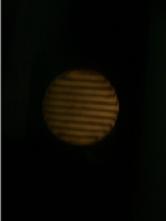
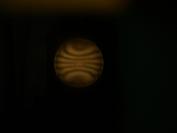
Now comes the most monotonous part of the entire process, polishing. Here, the concave surface of the glass is to be polished back to transparency. Now, the glass is not to be ground with another piece of glass, but with a grooved bitumen surface, due to which risks of scratching the surface are greatly reduced. Carborundum powders are no longer used, ferric oxide solution being used instead. Ferric oxide particles are very small, of the order of 2-3 microns. This small size allows it to clear the surface of its opacity. This part is the most time consuming part of the workshop, taking each student fifteen hours of polishing on average. Here, the focus is not on getting a clean surface, but on obtaining a suitable interference pattern (which indicates that mirrors curvature is optically correct to give sharp images). A few students stopped the polishing even though they had not obtained complete transparency, simply because the interference pattern observed was highly satisfactory and further polishing could have spoiled the pattern. The entire polishing process was completed on 15th of June. The mirror-glasses were now sent for aluminizing of the surface.
In the meanwhile, work was started on the housing of the telescope, i.e., the tube, the mirror cell and the mounting. The PVC tubes that would house the telescope were painted black on the inside. On the outside, slots for various attachments were affixed. The mirror cell (unit that holds the mirror) was also built of circular wooden discs and fitted into the tube. A small secondary mirror was mounted on a small stucture called spider. All the above took about four days to complete. The aluminized mirrors arrived on the 18th, and were also fixed into the tubes. As such, the entire tube was completed on the 19th of June.
On the last day, the 20th, the mounting and stands arrived. The tubes were now fixed on the stands. Testing was not possible, due to cloudy skies. Instead the telescopes were tested in the Instrumentation department itself. After 16 days of hard work, the students were finally able to take home their telescopes.
The participants were also provided with a ‘Nortan star map atlas’ and two books: ‘how to use a telescope’ and ‘night sky guide’. The workshop was an educational as well as fun-filled experience for the students; egging their interest further in the field of amateur astronomy. It was also a productive utilization of their vacation time.
These telescopes were funded partly by CoEP alumni. Each telescope costed Rs 7090/- The alumni funded $780/- for the event. The Astronomy club is thankful to the alumni for their generous funding. The astronomy club also thanks Mr. Tushar Purohit, without whose able guidance, the workshop would not have been possible. Special thanks also to Prof. S D Agashe, the club’s staff advisor and the Head of Dept of the Instrumentation and Control Department, for allowing us use of a seminar hall and other facilities in the department building for this workshop.
Mohit Karve
(FY. B.Tech Production)
Some Photos
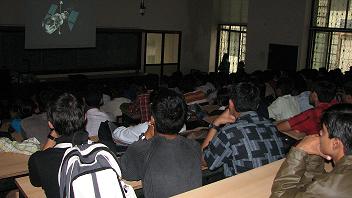 Screening of DVD “15 years of Hubble space
telescope” during club inauguration
Screening of DVD “15 years of Hubble space
telescope” during club inauguration
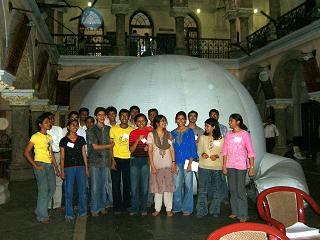 Mobile Planetarium
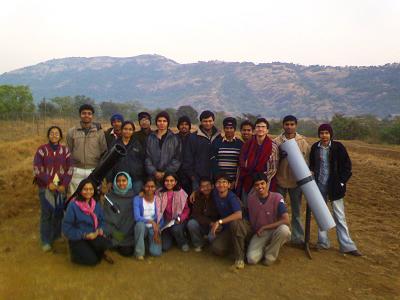 Kamshet Star Party
Partial
solar eclipse of 18 march,2007
Photographing
the partial solar eclipse at taljai hills,pune
Telescope
making workshop photos
Grinding
the mirror
Measuring mirror focal
length
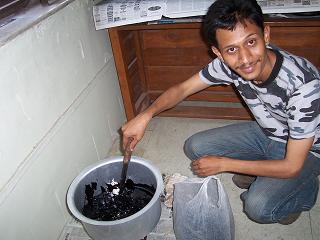 Melting bitumen on stove
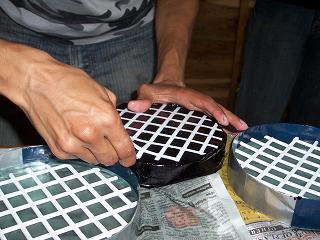 Making pitch tool from molten bitumen for
polishing the tubes
Making pitch tool from molten bitumen for
polishing the tubes
Interference pattern
of an imperfect mirror interference pattern of
a perfected mirror
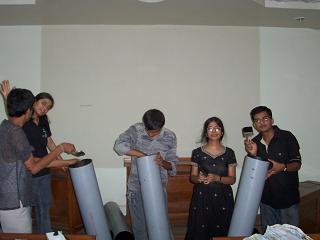 Painting the inside of PVC tube with blackboard
paint
Painting the inside of PVC tube with blackboard
paint
Eight telescopes ready to use!!